Uncategorized
Tabula Rasa
So Tabula Rasa is the theory that babies are born with a blank slate . . . meaning they know nothing in the beginning. Every experience they have fills their slate [read that, mind] and makes them who they are.
This is my mind right now. I want to claim that there was a glitch in the system, and the whole hard drive just crashed. Perhaps it was a burn out. Nevertheless, there we are.
So I’ve seen others do this and I’ve been saving the idea for just such a moment as this: Go ahead, ask me any question you would like, and I may or may not answer it in the next post.
And in the mean time, feel free to add your vote to the last This vs. That debate if you haven’t already. The results are coming next week! Don’t get too excited, now. 😉
And now go, and have a wonderful weekend!
Speak up:
12 comments| TAGS:
Blank Slate, question, Tabula Rasa, This vs. ThatOver-analyzers Anonymous
Hello, my name is Juanita, and I’m an over-analyzer.
*Hello, Juanita* (Yes, I did just speak for all you in the blogosphere. I hope you don’t mind.)
So here’s her story:
According to this blog I . . . I mean, she read (you know, the kind that stalks agents), she heard that Agent Super totally makes full requests on every query she gets on days with a Blue Moon.
So she did it, she waited until the next Blue Moon to submit, but then she didn’t get a reply back within Agent Super’s usual ten minutes, and by the time an hour had passed, she was totally freaking out! I mean, seriously!
Since she knows this Agent has impeccable taste, and she knows said Agent responds within minutes (according to the said blog), and that Agent Super ALWAYS requests a full on Blue Moon days, . . .
then the ONLY POSSIBLE conclusion is that her manuscript is HORRIBLE!
Yes, Juanita is an over-analyzer. She latches on to a little detail (which may or may not be true, depending on the context) and then lets her mind run with it. And of course, her mind uses LOGIC and “FACT”-BASED EVIDENCE to make conclusions that are sure to tear her self-esteem to shreds.
And there’s no escaping it, because it’s all sitting in that pretty little head of hers, and no matter how busy she may keep herself, her brain has this extra 90% that isn’t being used, so it has plenty of room to keep analyzing, and analyzing, and analyzing, and analyzing, and analyzing,
and analyzing,
and analyzing,
and analyzing,
and analyzing,
and analyzing,
and analyzing,
and analyzing,
and analyzing . . .
Well, you get the point. Poor Juanita.
Lucky for her, there IS a cure. But unlucky for her, I’m not sure what it is, so I’m hoping you all can help Juanita out . . . What do you do to keep your brain in check when it threatens to hi-jack your sense of reality?
*Note: Super Agent and Juanita are fictitious characters. Any resemblance to persons living or dead is a complete coincidence. Really.
Speak up:
17 comments| TAGS:
Brain, over-analyzers anonymous, Super AgentLicense Plate Trivia Revealed
So wow, I was impressed with how many of you got the color right! *wink, wink*
For those of you just tuning in, the license plate was
ROS3RED
My readers were charged with guessing the color, make and model.
But alas, no one got it exactly right. Stina Lindenblatt was the closest with the guess of a Red, Toyota, Sienna.
Red, yes. Toyota, yes. Sienna, no.
Speak up:
16 comments| TAGS:
candybar, Mystery prize, personalized licence plates, Stina Lindenblatt, Toyota CorollaConquering Clichés, Part 4: Using Them . . . or Not
As writers, we are told so often to “Avoid Clichés,” that the warning has pretty much become a cliché itself. Ah, the irony. In the last post in this series, we discussed several reasons to cut clichés, but it’s good to note that there are moments when clichés can work.
I can think of two valid reasons for using them:
1. Establishing a Character.
People speak in clichés. It’s a natural thing. While I don’t think that means you should fill your characters’ dialogue with clichés, you might use them to establish a type of character.
- An old granny who has a proverb/idiom for every situation.
- A ranch-workin’ cowboy transplanted into a New York boarding school.
- A Budda monk who lives in a monastery on top of Mount Kismet.
- A parent arguing with a teenager who missed curfew.
You get the idea. The clichés they use build their character—show us who they are—place them in the world of your book. Still, the clichés should be used responsibly. Be sure they build up your character, rather than pull the character into the quagmire of overuse.
2. As Irony or Humor.
When you are using a cliché with the specific purpose of mocking it, I think it works. Clichés can be a lot of fun to play with. And because they are so well known (you know, from being overused), they make good joke bait.
For example, in Sorcerer’s Apprentice (you have seen this movie, haven’t you?), they use a plot cliché (namely Jedi mind-control) so the bad guy can get the information he needs. So just when I’m thinking, Huh. That reminds me an awful lot of Star Wars, his apprentice, the comedic sidekick, waves his hand and says in a mock-serious voice, “These are not the droids you are looking for.” Okay, so maybe you have to see it, but it totally worked. Because they made a mockery of the cliché, I not only forgave it, but now think it’s one of the best parts of the movie.
A word of caution: even though clichés may work in such situations, we need to be careful not to overdo it. What is funny once can fall flat the second or third time.
To end this series, I want to recognize that clearing out clichés that have crept into our writing is never easy. It takes work and effort. It often requires thinking outside the box. One of the best resources I know of to help your mind envision the possibilities is The Bookshelf Muse.
On the sidebar of their blog, you will find a wonderful assortment of Thesauruses: Setting Thesaurus; Emotion Thesaurus; Colors, Textures and Shape Thesaurus; and a Symbolism Thesaurus. Angela and Becca are nothing if not thorough, and they are constantly adding entries. I highly recommend you visit them for help with conquering clichés.
Again, I don’t claim to be an expert. Hearing others’ opinions and ideas is always good. So in the comments, please feel free to share other situations where you think using a cliché would work, other resources you know of to help conquer clichés, and any differing view you may have.
If you missed the first 3 parts, feel free to follow the links:
Conquering Clichés, Part 1: Introduction
Conquering Clichés, Part 2: Ways to be Cliché
Conquering Clichés, Part 3: Why We are Cautioned Against Them
Conquering Clichés, Part 4: Using Them . . . or Not
Speak up:
12 comments| TAGS:
clichés, humor, Sorcerer's Apprentice, The Bookshelf Muse, ThesaurusesPay It Forward
Shelli, over at Market My Words, is having a Pay-It-Forward Contest. One of the requirements to enter is that you recognize in a blog post (or on Facebook) someone who has helped you in some way.
I love the idea of paying it forward, and I am an advocate of giving thanks, so I am excited to share. And I didn’t have to think long about who I wanted to thank.
Back when I was first introduced to the writing blogosphere by my fabulous CP Vicki, before I even kept a writing blog, I read a post about a writing contest over at Laurel’s Leaves. It was her Eleventy-one Celebration Writing Contest where she wanted a scene showing negotiation and persuasion.
I decided to enter, and lo and behold, I won! I was astonished . . . and even more astonished when she gave the break down on her blog of why she chose my piece.
I can’t express what it meant to me to have a complete stranger (at the time) say such kind things about my writing. It was just what I needed to hear right then. It boosted my confidence, and it was the catalyst that led to my starting a writing blog and to the drive to finally finish editing my book.
I just wanted to tell Laurel thank you for your contest and for your kind words. It all meant much more to me than I’m sure you could have guessed.
THANK YOU!
And in the spirit of thanks, feel free to give a shout out to someone who influenced your life for the better. 🙂
Speak up:
19 comments| TAGS:
confidence, Laurel's Leaves, Market My Words, Pay It ForwardLicense Plate Trivia
It’s been way too long since I did one of these. So for those who haven’t played before, guess the Make, Model, and Color of the car with the following license plate:
ROS3RED
First person to guess correctly can choose between their favorite candy bar or a mystery prize (which may or may not be as good as the candy bar *insert evil laugh here*).
P.S. If you haven’t weighed in on the last This vs. That post, please do! I hate to beg, but I’d love more opinions . . . it’s a TOUGH decision. 😉
P.P.S. Garrett, I still owe you . . . I’ve been searching for that Cadbury Egg, I may have to go with your back-up. Just didn’t want you to think I’d forgotten!
Speak up:
15 comments| TAGS:
Cadbury Eggs, candybar, Evil laugh, Mystery prize, personalized license platesHow to Find the Google Searches That Led to You
After Monday’s post, I had a few people ask how to find the Google searches I was referring to. I thought a how-to post would be relevant.
However, I am no expert, and I only know Blogger. So for my readers who know more or use other blogging sites, I would love it if you would share your tips and suggestions in the comments.
And here we go:
1. Starting from your Dashboard: Look for the heading “Stats” on the far right from “New Post.” I’ve highlighted in the picture below.

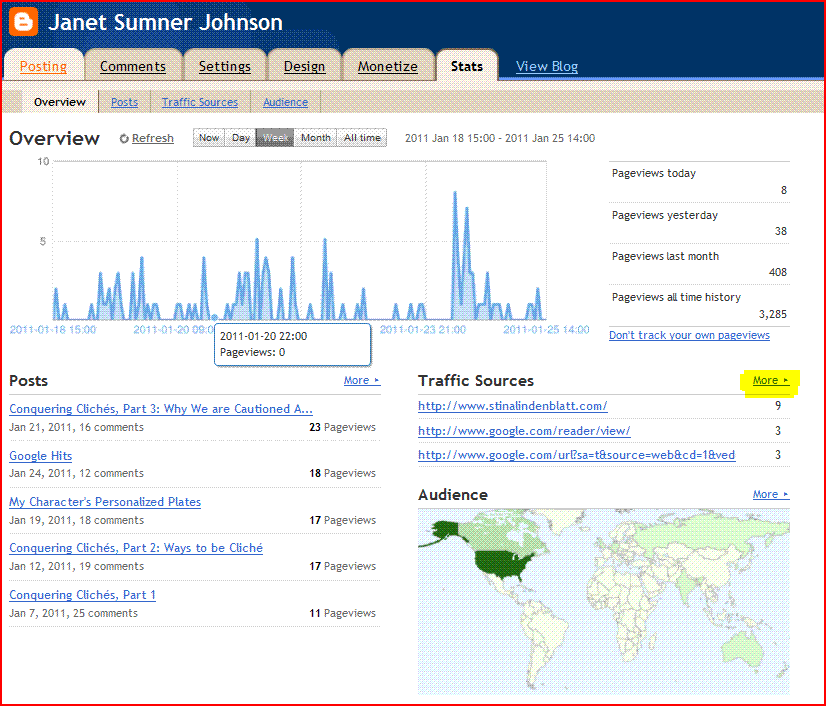
2. On the Stats Page: Click on “More” next to the heading “Traffic Sources” on the middle right. I’ve highlighted it in the image below.
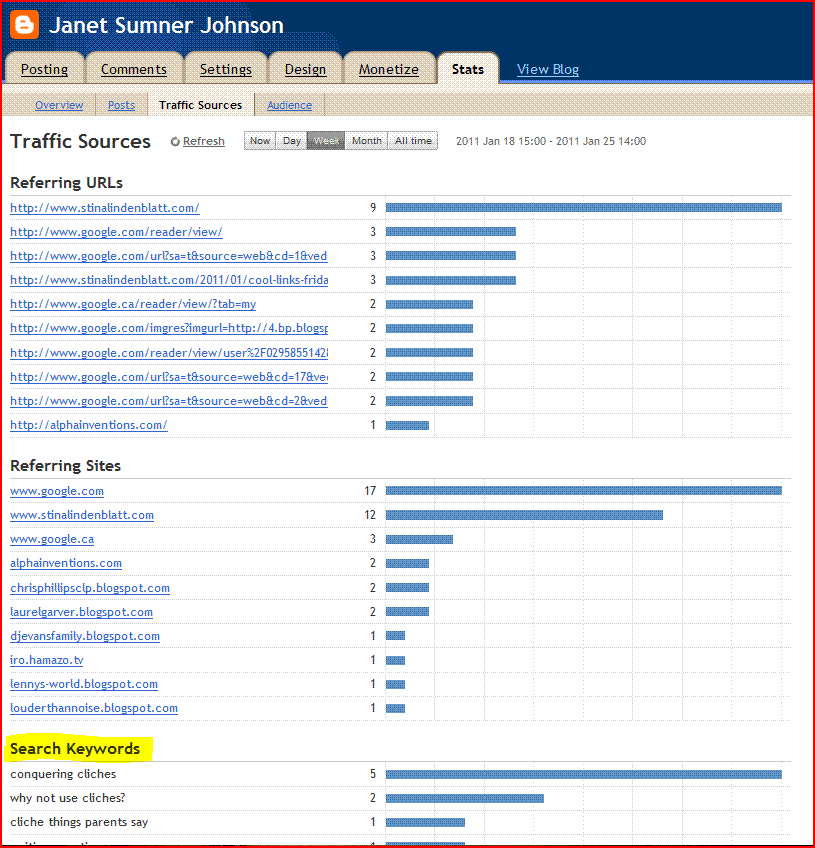
3. On the Traffic Sources Page: Look toward the bottom at “Search Keywords” and voila! There you are. Again, I’ve highlighted it in the image below.
There you are, nice and easy. And while you’re there, spend some time and take a look around. The information under the “Stats” tab is pretty interesting!
And there are other ways to do this, too. If you load a free stats counter through sites such as blogpatrol.com, they will also list keyword searches that led someone to your blog. Just follow their instructions for loading the counter.
Hopefully that was helpful for you. And if you know of other ways to do this, please share!
Speak up:
17 comments| TAGS:
bloggers, blogpatrol, Google hits, Stats TabSmart Advertising
Flipping through the local grocery ads, I couldn’t helping laughing at (and to a certain extent, admiring) the creativity of this promotion:

Now that’s what I call thinking outside the box.
Speak up:
13 comments| TAGS:
Advertising, Edy's Ice-cream, Grocery ads, Lean CuisineGoogle Hits
A favorite amusement of mine is looking at the Google Searches that led to my blog. Surely I’m not the only one who does this. Right? Anyway, some of the hits make total sense.
For example, I get a surprising number of hits for “patience vs. waiting” (surprising that so many people look that up). With a blog post titled “Waiting vs. Patience” I come up as the first hit. That makes sense. Every now and then I get a hit for “double-jointed thumbs.” Okay, I’ve touted mine enough that I can see the connection. And “what are the two squiggly lines on my license plate.” Yup, with my license plate fetish, no questions there. And just so you know, I have no idea about the squiggly lines. Sorry to the next guy (or girl) who ends up here.
But how in the heck did my blog come up after this query: “where do you look at Christmas lights in Sumner”? . . . Oh wait. “SumNer” instead of “SumMer.” Still, I can’t repeat the results. They must have been on page 20 of the results or something.
And another: “things said that make you laugh.” While I’m flattered that would lead someone to my blog (he he), I can’t duplicate that either.
Another hit came from a search for “hilary mckay.” Yeah, I’m baffled, too.
How about “too many compliments sound fake.” So what is that saying? That I sound fake? I can’t believe Google would have the audacity to connect me to that! 😉 Oh yeah, this may just mean a future post on this very subject. Maybe.
Do you do this? And if so, what are the craziest search words that led to your blog?
Speak up:
14 comments| TAGS:
Christmas lights, compliments, Google hits, Hilary McKay, personalized license platesConquering Clichés, Part 3: Why We are Cautioned Against Them
So now we know what clichés are. We can recognize them in their various forms. We also know that we shouldn’t use them.
But why? If they say exactly what we want to say, why not use them?
Here is what I came up with:
1. Clichés are boring.
By definition, clichés are overused. We’ve seen them before (WAY too many times). And frankly, we, as readers, are just plain tired of reading them. This applies especially to plot clichés (see part 2). After the first time, you can only take so many mistreated orphans who suddenly discover they have magical abilities, and thus thwart their evil relatives. And if you need a laugh and aren’t sure what other plot clichés might exist, check out this site.
Furthermore, when a character’s heart is pounding all the time (another of my weaknesses), you start to wonder if they’re going to have a heart attack.
2. Clichés suggest laziness.
I have done the stare-at-the-computer-trying-to-come-up-with-the-perfect-description thing. It stinks. A lot. It’s so much easier to use a pre-fabbed phrase that really does say what you want. But it’s never as effective. Likely it’s not even your voice. Really, it’s just lazy. (Note: I TOTALLY allow myself to use clichés on a first draft . . . just don’t let them stay. . . unless they should.)
3. Clichés can be a red flag for that agent or editor you’re hoping to impress.
Okay, I’m no agent or editor, but if I saw as many projects as they do on a daily basis, I might just be looking for a reason to reject a few. You know, those pesky typos, queries addressed to Mr. instead of Ms., an abundance of clichés in the writing . . . You read enough, and I bet those clichés stand out like sore thumbs. 😉
4. Clichés are often word padding.
Sometimes, we’re trying to dress up our writing and unawares, those clichés sneak in. They add to our wordiness without adding to the meaning.
For example: Michael improved by leaps and bounds.
Do we really need it? No. Michael improved. Period.
5. Clichés don’t always mean what you think they mean.
This is particularly in reference to those proverb and idiom clichés (see part 2). These phrases are so common, and such a part of our culture, we don’t stop to question the meaning (which may not be the same for everyone).
In the Cliché Dictionary (Ammer, Christine, The Facts on File Dictionary of Clichés, New York: Facts on File, Inc., 2001.), the phrase “eat one’s heart out” is defined as “worrying excessively.” Another definition that she cites almost as an afterthought is “doesn’t that make you jealous.” Uh, what? I had never heard that first definition. I’ve always seen it as the second. Maybe I’ve been misunderstanding people for years!
And I had to have a friend explain “You can’t have your cake and eat it, too.” That never made sense to me. Because if you have your cake, why can’t you eat it? It’s there for the taking right? (Definitely a duh moment.)
The point is, the definitions attached to these things aren’t necessarily the same for everyone. You may think you are expressing your ideas perfectly, while your reader is all kinds of confused.
Again, I don’t think all clichés should be banned. But consider these reasons for cutting them from your writing. Are they really pulling their weight? Are they doing what you intend for them to do? Are they improving your work or making it boring? Is the meaning clear?
In Part 4, I’ll talk about when cliche’s work, and how you can fix them when they don’t. And if you missed the first 2 parts, feel free to follow the links:
Conquering Clichés, Part 1: Introduction
Conquering Clichés, Part 2: Ways to be Cliché
Conquering Clichés, Part 3: Why We are Cautioned Against Them
Conquering Clichés, Part 4: Using Them . . . or Not